
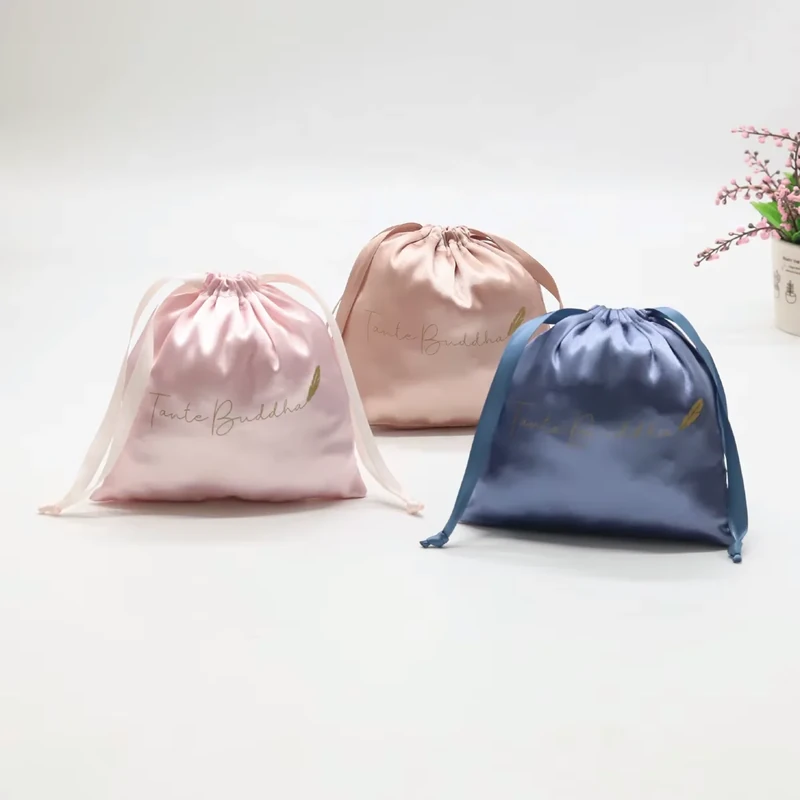
Satin gift pouches suit a design brief centered on a smooth, lustrous appearance; a matte woven cotton pouch suits a different visual direction. Neither choice is automatically more luxurious, reusable or protective. Select the actual fabric around the gift, its presentation and the recipient's opening experience, then confirm the dimensions and branding in a filled sample.
The terminology matters: satin is a weave description, while cotton is a fiber. In this guide, the practical comparison is a specified satin fabric against a specified matte cotton fabric, rather than two mutually exclusive fiber categories.
1. Identify what is behind the surface appearance
Satin does not mean silk. Ask for fiber content even if the swatch has a smooth, shiny face. CottonWorks describes satin weave through its longer surface floats and resulting smooth, lustrous face; the weave description by itself does not supply the fabric's composition. CottonWorks woven fabric designs.
Likewise, “cotton” leaves the weave, weight and finish undecided. A light cotton fabric, a cotton canvas and a cotton fabric with a different surface finish can create very different gift pouches. Define the particular fabric you want to compare rather than treating all cotton as one look.
Inspect both faces of the swatch and a folded edge. If the pouch is unlined, the reverse face contacts the gift. If it is lined, specify that layer separately. Confirm whether the visible surface in the approved sample will be used consistently on the outside and whether fabric direction changes the appearance under the display lighting.
2. Compare complete presentation concepts
The table below proposes a controlled sampling comparison. Sizes, weights and trim dimensions are illustrative development briefs, subject to suitable material availability and sample results. They are not stock specifications or industry standards.
| Detail | Satin concept | Matte cotton concept |
|---|---|---|
| Fabric brief | Satin weave, composition confirmed, proposed 90–120 GSM | Cotton plain weave, proposed 140–180 GSM |
| Outer flat sample | 15 × 20 cm | 15 × 20 cm |
| Initial closure | Proposed 10 mm ribbon | Proposed 3 mm cotton cord |
| Intended presentation | Smooth reflected highlights | More matte, visibly textile surface |
| Logo trial | Small heat-transfer or screen-print sample, subject to suitability | Screen-print sample and optional printed label |
| Main check | Surface change, gift outline and ribbon operation | Gathering, opacity and small-print clarity |
These fabric weights do not establish equal thickness or performance. Keep the same gift inside both samples. Look at the pouch on a table, in a hand and under the light used for product photography. A surface that looks appealing in a close-up can make a small logo harder to read at normal viewing distance.
3. Choose a size from the complete gift
Measure the gift with its box, cap, card and wrapping included. Then decide whether the mouth should close fully or produce a particular bow and gathered shape. An oversized pouch can hide a small gift; an undersized one can emphasize corners and make removal awkward.
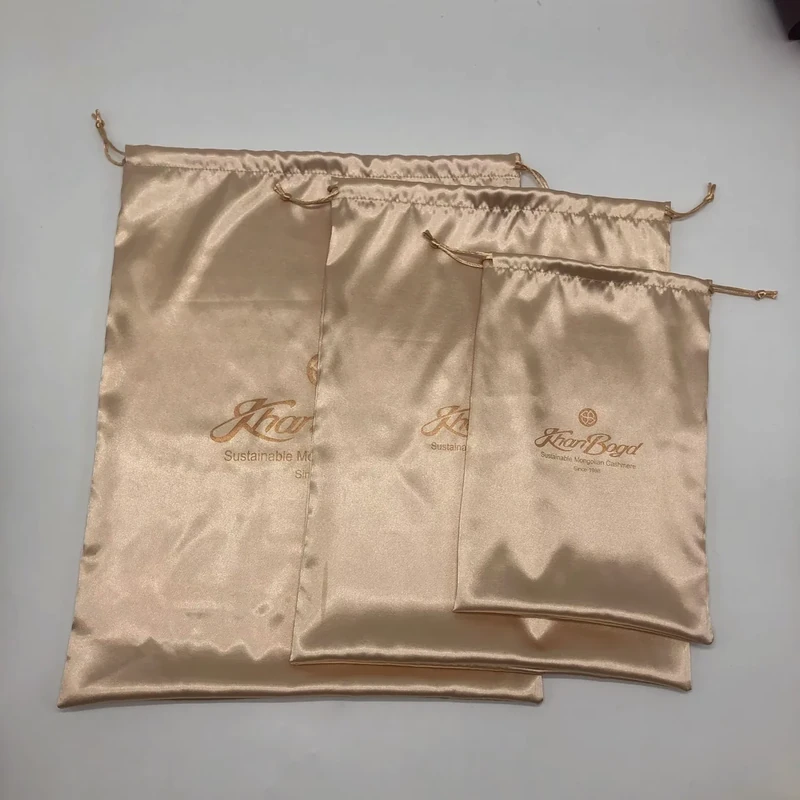
The examples below are sample starting points. Flat sizes mean empty finished outer W × total H, with the drawstring channel included. Inches are approximate at 1 in = 2.54 cm. They do not describe internal dimensions.
| Presentation to evaluate | Flat size, cm | Approximate inches | Fit question |
|---|---|---|---|
| Small carded gift | 9 × 12 | 3.5 × 4.7 | Is the card below the closure area? |
| Compact boxed or wrapped gift | 15 × 20 | 5.9 × 7.9 | Is there room for depth and gathering? |
| Taller gift presentation | 15 × 23 | 5.9 × 9.1 | Does added height improve the closed shape? |
| Broader accessory gift | 18 × 24 | 7.1 × 9.4 | Can the recipient remove it comfortably? |
| Larger gift arrangement | 25 × 35 | 9.8 × 13.8 | Does the opening accept the complete arrangement? |
When the contents have significant depth, evaluate a gusset as a separate design. State its empty shaped outer W × H × D and draw the depth direction. A flat width cannot simply be converted into a gusseted width while assuming unchanged capacity.
4. Work through a small gift-box example
Suppose a box measures 10 cm wide, 12 cm tall and 3 cm deep. As a rough envelope check for a flat pouch, 10 + 3 = 13 cm before ease. Start with a 15 × 20 cm sample, leaving the actual internal clearance to be verified after seams and the closure are made.
Place the complete box and its intended card inside. Check whether the box corners pull the front panel tight and whether the top fabric gathers freely above it. For a satin sample, observe the highlights around the corners. For cotton, inspect how the upper folds frame the logo. These are presentation differences to assess, not proof that one material protects the box better.
If the sample fits but the bow occupies too much of the front, compare a taller 15 × 23 cm version or revise the ribbon arrangement. If the box enters only diagonally, examine opening width and seam construction instead of automatically adding height.
Have someone else open and repack the gift. Their handling can reveal that a neat bow requires too much effort or that the cord ends are difficult to grip. Approve a repeatable presentation that staff and recipients can achieve without a detailed demonstration.
5. Treat ribbon, cord and logo as one design
Ribbon and satin often appear together, but a satin pouch does not require ribbon, and cotton does not require cotton cord. Cotton cord, polyester cord and ribbon can be considered according to the fabric, channel and intended closing action.
For a small gift pouch, compare a proposed 6 mm ribbon with 10 mm ribbon, or a 2 mm cord with 3 mm cord. Keep the comparison focused: width affects the appearance of the tie, while thickness, surface and channel construction affect operation. Confirm material composition separately from the ribbon's width.
Position the logo below the area that disappears into the gathered mouth. On a 15 × 20 cm sample, a 4–6 cm wide logo can be an initial artwork comparison. It is not a guaranteed decoration area. Use the actual filled pouch to judge scale.
Screen print, heat transfer, embroidery and woven or printed labels are options to assess by material and artwork. Check whether the process changes sheen, creates visible puckering or adds an uncomfortable reverse surface. WisePouch uses partner processing for printing and embroidery; feasibility should be confirmed before treating a mockup as a production specification.
6. Approve color, care and repeat-order details
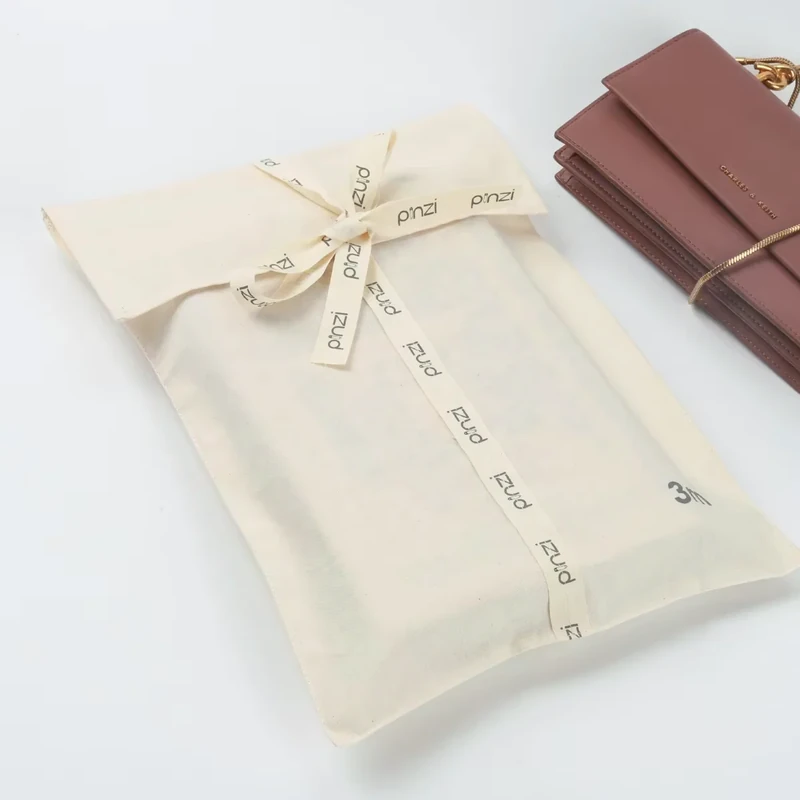
For a coordinated gift collection, record fabric, ribbon or cord and logo colors separately. A visually matching ribbon is not necessarily the same material or dye reference as the pouch. Evaluate the whole assembly under agreed lighting rather than approving isolated screen images.
If the customer is expected to keep and clean the pouch, define that intended use and evaluate the complete decorated sample under the proposed care conditions. Do not add machine-wash claims because the fiber is cotton or assume satin must always be handled in one particular way. Care depends on the actual construction, trims, finish and decoration.
Compare quotations with the same size, contents, quantity, artwork and packing arrangement. Ask whether changes in color count, ribbon, lining or labeling affect the quote. Document the final exterior dimensions and tolerance, channel design, tail or bow presentation, approved artwork and packing method.
An approved physical reference is particularly valuable when the design relies on reflective appearance. Keep it with the written specification so a later reorder does not drift toward a different satin finish or cotton texture while retaining the same material nickname.
Conclusion
Choose satin or cotton gift pouches by the complete presentation you want to create. Define the fabric behind the surface, allow for the gift's thickness and closure, and test the actual logo and trim. A well-sized, easy-to-open pouch gives either visual direction a clear purpose.
Key Takeaways
- Satin describes a weave and does not establish silk content.
- Compare exact fabrics with the same gift and outer dimensions.
- Include the channel in total height and leave room for gathering.
- Approve trim, artwork and surface appearance as one finished item.
Frequently Asked Questions
Not necessarily. Satin identifies a weave, so request the exact fiber composition. Do not describe a pouch as silk unless the actual material specification supports that description.
Reuse depends on the completed design, durability requirements and what the recipient does with it. A suitable size and practical opening may support continued use, but the fiber name alone does not establish a reuse count or environmental benefit.
Compare the closing action and the intended appearance on a filled sample. Ribbon may suit a bow presentation; cord may suit a simpler pull closure. Material, width or diameter, channel clearance and end finishing all need confirmation.
There is no universal size difference. Begin from the same contents and sample dimensions, then adjust for the actual fabric, seams, lining and closure. Use observed fit rather than an automatic material-based allowance.
It can be evaluated, but gathering may obscure or distort it. Check the filled and closed pouch before approving placement. Artwork dimensions and its distance from the channel should appear on the production drawing.
Related Resources
- Cotton versus canvas pouches compares lighter and more substantial cotton constructions.
- Drawstring cord materials covers closure selection.
- Custom gift pouches presents development options for branded packaging.
Share your gift dimensions, preferred surface and artwork through Contact WisePouch to begin a sample comparison.
Share your product dimensions, intended use, preferred fabric, closure, logo artwork and estimated quantity. We can review the details needed for a quotation and sample.
Discuss Your Pouch Project