
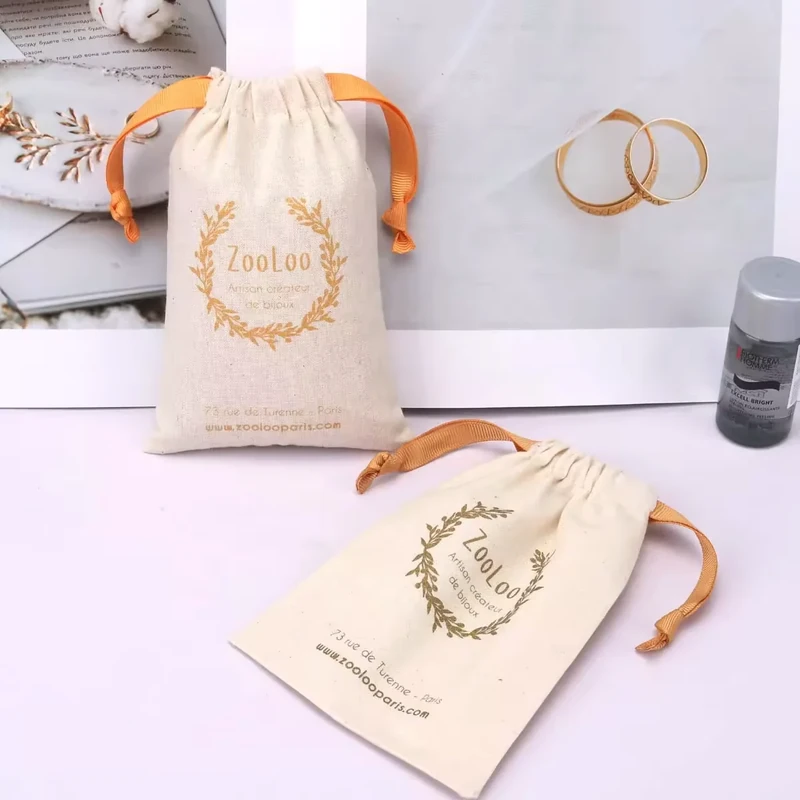
A single drawstring pouch usually gathers from one side; a double drawstring pouch commonly uses two separate cords pulled from opposite sides. The better choice depends on how the pouch is filled, held and reopened. Double pull can make a presentation pouch easier to gather symmetrically, while single pull can suit a simple storage bag with less external trim. Neither description establishes carrying strength or a completely sealed opening.
The word “double” is especially easy to misread. Two visible ends might belong to one cord, and two cords do not automatically create two independent handles. Confirm the actual route before choosing cord thickness, channel size or a finished pouch dimension.
What Single and Double Drawstring Actually Mean
For this guide, a single-pull route means one continuous cord passing through the front and back channels, with both ends emerging on the same side. A double-pull route means two continuous cords taking that route in opposite directions: one returns to the left opening, and the other returns to the right opening. There are other constructions, so include a sketch with the purchase specification.
On the double-pull route described here, each channel contains two moving cord runs. Each side has two exposed ends, which can be joined by a knot. That is four exposed ends in total, but still only two continuous cords. Counting visible tails is not the same as identifying how tension passes through the closure and into the stitched fabric.
Cord routing is separate from cord fiber and construction. Cotton and polyester describe materials; braided and twisted describe how yarns are assembled. Marlow's manufacturing explanation makes that material/construction distinction clear. A cotton cord can be used in either closure route; choosing double pull does not require polyester.
Compare the Opening and Closing Experience
Try the closure with the product inside, because fabric gathered around an empty pouch is an incomplete demonstration. A rigid box can hold the sides apart, while a soft scarf allows the mouth to gather much farther. A small remaining central opening may be acceptable for presentation but unsuitable for loose tiny components.
| Decision | Single pull, as defined here | Double pull, as defined here |
|---|---|---|
| Closing action | Hold the pouch and gather toward one exit | Pull the left and right cord groups apart |
| External appearance | Cord tails mainly on one side | Cord tails on both sides |
| Channel occupancy | One moving cord run in each channel | Two moving cord runs in each channel |
| Packing consideration | Check that the mouth opens without pulling an end into the channel | Check that both cord groups move freely and reopen evenly |
| Best reason to choose it | Simple trim and familiar one-sided operation | Balanced presentation and two-handed closing |
| Point to verify | Gathering may need help from the other hand | Added cord bulk must suit the fabric and channel |
A double closure is not necessarily a locking closure. Knots joining cord ends stop those ends separating; they do not always keep the gathered mouth tightly shut. If the package must stay closed during a specific shipping or handling sequence, demonstrate that sequence with the intended insert and outer packaging.
Match Cord Size and Channel Space to the Pouch
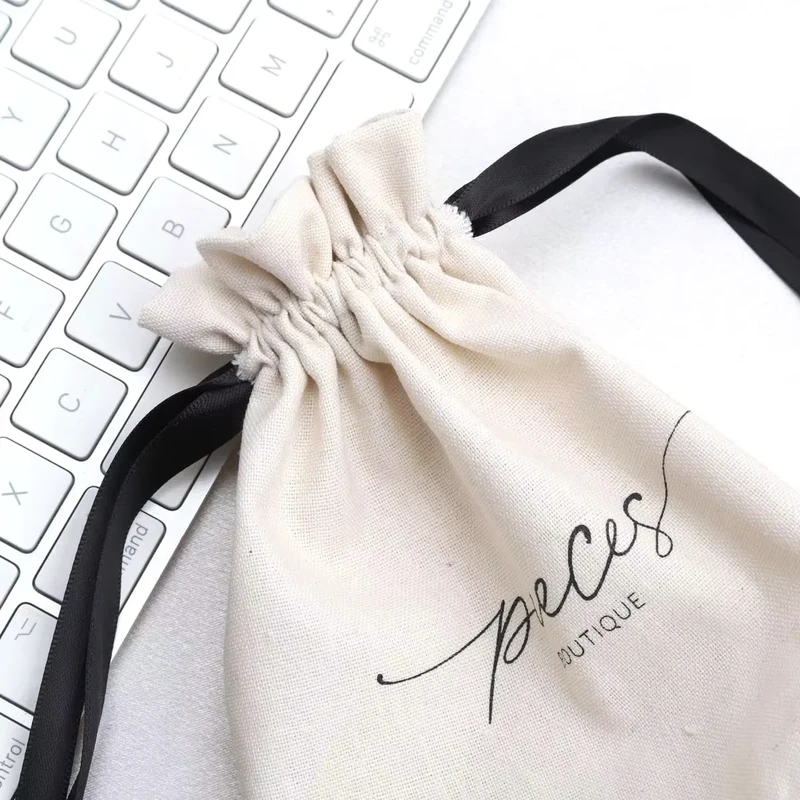
All dimensions below are sample starting points, not stock specifications, universal rules, minimum manufacturing capabilities or carrying ratings. Pouch sizes are empty finished outer width × total height, including the drawstring channel. Cord diameter is approximate; soft braid can flatten under measurement. “Channel depth” means the finished clear distance from the channel's upper inside fold to the lower stitch line, not the fabric strip's cut width.
| Proposed pouch | Closure to sample | Cord or ribbon trial | Clear channel depth to compare |
|---|---|---|---|
| 10 × 14 cm jewelry or token pouch | Double pull | 2 mm round cord | 8–10 mm |
| 18 × 24 cm gift pouch | Double pull | 3 mm round cord | 12–15 mm |
| 25 × 30 cm accessory dust bag | Single and double pull | 3–4 mm round cord | 15–18 mm |
| 35 × 40 cm handbag dust bag | Double pull | 8–10 mm flat ribbon | 18–22 mm |
These are paired trials rather than a mathematical clearance formula. Two round cords may sit beside one another, shift or overlap as fabric gathers. A ribbon must lie reasonably flat while still passing folds and joins. A sufficiently wide channel can still jam if a seam allowance obstructs the exit or a stitch catches a cord.
Compare the finished channel, the smallest opening at its exit and any folded seam junction. Enlarging the entire pouch will not fix an obstructed exit. Conversely, narrowing the cord to overcome a badly constructed channel can make the hand feel worse without addressing the cause.
Work Through an 18 × 24 cm Gift Pouch Sample
Suppose a brand packs a rigid gift measuring 10 × 12 × 4 cm. An 18 × 24 cm flat pouch is a reasonable prototype to investigate, not a guaranteed fit: the gift's depth takes up some of the flat width and height, and fabric must remain above the gift to gather.
Request two otherwise identical cotton samples. Use a single-pull route on Sample A and a double-pull route on Sample B. Start with approximately 3 mm cord and a proposed 14 mm clear channel depth. Specify both outer dimensions and the channel definition, then insert the actual wrapped gift rather than an unwrapped substitute.
Open each sample fully, insert the gift and close the mouth without pressing the box corners into the channel. Note the remaining opening, the amount of fabric above the product, whether the cords drag and whether staff can reopen the pouch without searching for an end. If the product blocks gathering, first consider added usable height or a different bag shape; extra cord length alone will not create space above the box.
For branding, a proposed 60 × 25 mm logo could sit horizontally centered, with its lower edge 45 mm above the finished bottom seam. This is a sample placement, not a maximum print area. Photograph that mark with the gift installed and the drawstring closed. A logo that looks centered on the empty rectangle can tilt or disappear into folds when packed.
Specify Cord Ends, Knots and the Intended Load Path
Cord length should follow the drawn route and a prototype. The specification needs the fully open mouth, the closed state, the required tail or bow appearance and the amount consumed by knots or other approved end finishing. Avoid ordering from an unexplained “twice the width” calculation: it may describe one route but omit the second channel, return path or finishing allowance.
Record the number of continuous cords, the number of moving runs inside each channel and the exits used. For a proposed carrying use, also identify the strands actually held in the hand and the stitches or attachments receiving force. The four visible ends of the double-pull example are not four independently rated supports. Fabric, seams, exits, knots and the user's grip all affect the assembled result.
Choose knots and tips with the packed product in mind. A bulky hard tip can press against a jewelry box or mark a soft item during storage; an unfinished end may fray or retreat into a channel. Check the approved finishing on the actual trim. Do not assume a heat-cut finish suitable for one fiber will be suitable for another.
Common Mistakes to Catch Before Ordering
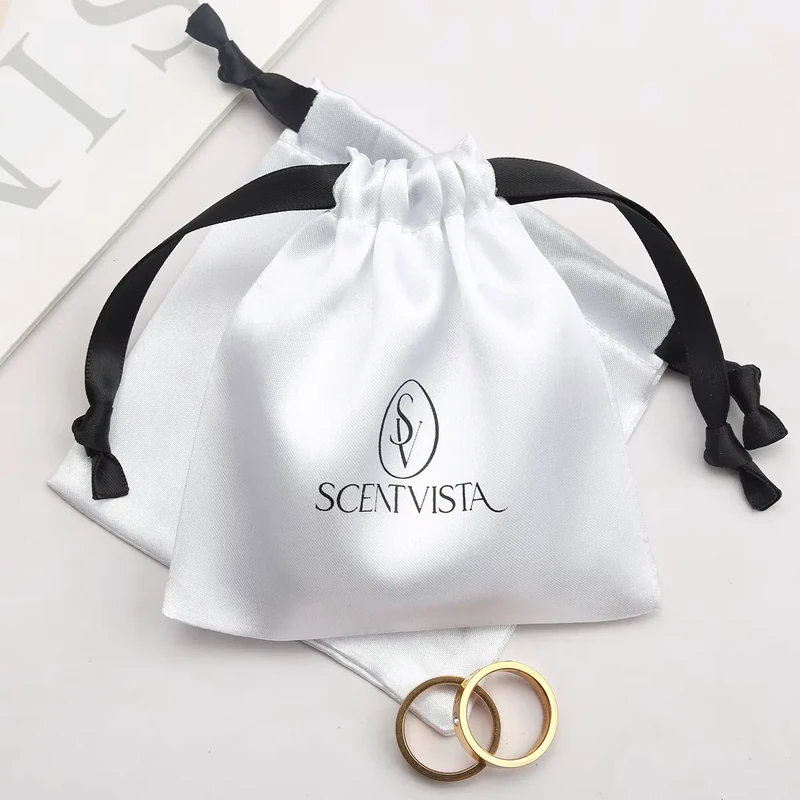
One mistake is approving a flat drawing with “double drawstring” as the only closure instruction. A second is approving a loose cord swatch without the channel and seam construction. A third is treating a more substantial-looking cord as proof of carrying strength. Each leaves a different part of the design undecided.
Also check opening recovery. Some users loosen the mouth by pulling its fabric edges; others pull a cord in the wrong direction. Have somebody unfamiliar with the pouch open it, fill it and close it. Observe whether a knot disappears into an opening, one side remains partly gathered or ribbon twists into a narrow rope-like bundle.
Keep a written record of the accepted route and sample behavior. If the order later changes to thicker fabric, a lining or wider ribbon, revisit the closure. Those changes can alter friction and gathering even when the finished outer width and height remain the same.
Conclusion
Choose single or double drawstring by the operation you want, then develop cord size, channel space and pouch dimensions together. The useful approval sample is the one that closes around the real product and reopens comfortably with the specified routing and finishing.
Key Takeaways
- Define single and double pull with a route drawing; names alone are ambiguous.
- Count continuous cords and channel runs separately from visible ends.
- Trial channel depth and exit space with the actual cord, fabric and seams.
- Confirm packed appearance, logo position and intended handling before production.
Frequently Asked Questions
Not necessarily. The double-pull example here has front and back channels, with two cords passing through both. Some designs use a different channel arrangement. Specify the route and exits instead of relying on the word “double.”
The closure name does not establish strength. Added cord does not automatically strengthen fabric, stitching or exit points. If the bag will be carried by its cords, agree the intended contents and handling test for the complete sample.
Yes, ribbon can be considered where the pouch construction and presentation support it. Trial the ribbon's width, thickness and folding behavior in the finished channel. A narrow round-cord channel may need redesigning for flat ribbon.
It may gather the mouth closely, but it does not guarantee a sealed top. Fabric thickness, channel construction and the packed item determine the remaining gap. Test with the smallest items that must stay contained.
Approve the intended open and closed appearance first, then record the length proven by that construction. The final cut length must account for the complete route and knots or end finishing; an outer-width calculation alone is insufficient.
Related Resources
- Drawstring pouch size guide for relating flat dimensions to the contents.
- Drawstring cord materials for cotton, polyester and ribbon comparisons.
- Custom gift pouches for packaging styles to develop around your product.
Contact WisePouch with the product dimensions, proposed pouch size and a sketch of your preferred drawstring operation to discuss a sample.
Share your product dimensions, intended use, preferred fabric, closure, logo artwork and estimated quantity. We can review the details needed for a quotation and sample.
Discuss Your Pouch Project